The Ultimate Smartphone Buying Guide (2026): How to Choose the Perfect Phone for Your Needs
Everything you need to know about performance, display, camera sensors, battery life, AI features, and price tiers before making your next purchase.

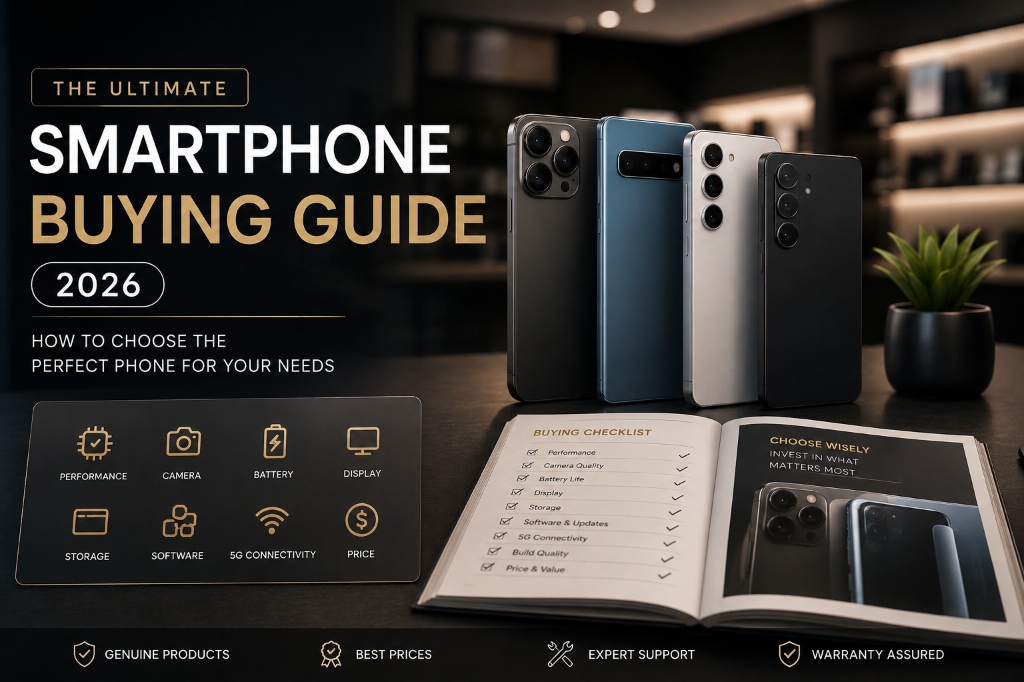
In 2026 the smartphone market offers a dizzying array of choices. Flagship phones now pack cutting-edge chips (e.g. Apple’s A18 or A19 Bionic, Qualcomm’s Snapdragon 8 Gen 4, Google’s Tensor G5), ultra-sharp displays (120–144Hz OLED, 1500–2600 nit HDR), multi-camera arrays (100–200MP sensors, 5× periscopes, LiDAR), and powerful AI features (on-device ML, generative AI assistants). Mid-range and budget phones have also improved (high-refresh OLEDs, 5G, 5000mAh batteries).
This guide breaks down the key factors when choosing a phone: performance, display, camera, battery/charging, software/AI, build quality, connectivity, storage, pricing tiers, trade-in/repair, accessories, and a final buying checklist. We provide comparison tables, a 6–12 month purchase timeline, FAQs, and CTAs tailored to Online Mobiles.
Table of Contents
1. Performance & Processors
Modern smartphones use very powerful processors. Flagship Android phones typically run Qualcomm’s Snapdragon 8 Gen 4 (or Gen 3) or Samsung’s Exynos 2400 series; top iPhones use Apple’s A18 / A18 Pro chip. For example, benchmarks show the Snapdragon 8 Gen 3 scoring ~7500 in Geekbench 6 (multi-core) and ~2.14 million in AnTuTu, outpacing Apple’s A17 Pro chip. The latest A18 Pro has a 6-core CPU and 16-core Neural Engine. Google’s Tensor G4 (in Pixel 9) is optimized for on-device AI but trades some raw speed.
High-end phones exceed 9000+ multi-core Geekbench. Enables 4K/8K video editing and 120fps gaming.
Apple A18 features a 16-core Neural Engine. Google Tensor G4 & Snapdragon Hexagon run LLMs on-device.
Vapor chambers & graphene sheets maintain top speed under heavy gaming without thermal throttling.
2. Display Technology
The display is your window to content. In 2026 nearly all high-end phones use OLED panels with high refresh rates (120–144 Hz) and HDR. Flagship displays often reach 1500–2600 nits peak brightness for outdoor daylight visibility. For example, Samsung’s Galaxy S25 Ultra has a 6.9-inch QHD+ (3120×1440) Dynamic AMOLED 2X panel at 120Hz (peak 2600 nits). The iPhone 16 Pro Max uses a 6.9-inch OLED with ProMotion (adaptive 1–120Hz) up to 2000 nits.
- Size & Resolution: Flagships (6.7"-7.2" QHD+), Midrange (6.4"-6.7" FHD+ 1080p), Budget (6.1"-6.5" FHD/HD).
- Refresh Rate: Aim for 90-120Hz for smooth scrolling. LTPO panels adapt down to 1Hz to conserve battery.
- HDR & Contrast: HDR10+ and Dolby Vision support on OLEDs yield true blacks and infinite contrast ratios.
3. Camera Systems & Sensor Specs
Cameras remain a primary selling point. Multi-lens setups handle everything from ultra-wide landscapes to telephoto zooms. Flagships use massive 1/1.3" to 1" main sensors: Galaxy S25 Ultra features a 200MP sensor, while iPhone 16 Pro Max packs a 48MP Fusion sensor with quad-pixel binning.
5x periscope lenses (120mm equivalent on iPhone 16 Pro Max, dual 3x/5x on S25 Ultra) capture distant subjects without digital degradation.
Apple Photonic Engine, Google Night Sight & Gemini AI, and Samsung AI engine enhance dynamic range, night portraits, and unwanted object erasure.
4. Battery Life & Fast Charging
Flagship smartphones carry 4500–5000mAh batteries. Midrange powerhouses like OnePlus Nord 4 and Vivo X200 Pro boast up to 5500–6000mAh. Wired charging ranges from 25W–45W (Samsung & Apple) up to 100W on Android. Wireless charging supports Qi2 and MagSafe at 15W–25W.
5. Software, OS Updates & AI Features
Apple’s iOS 18 brings Apple Intelligence generative tools to iPhone. Google Pixel 9 and flagship Androids run Android 15/16 with built-in Gemini Live assistant. Flagships now pledge 5 to 7 years of major OS upgrades and security patches, making long-term ownership far more viable.
6. Smartphone Price Tiers Comparison
| Tier | Typical Price | Key Features & Specs | Target Audience |
|---|---|---|---|
| Flagship | ₹75,000 – ₹1,50,000+ | Snapdragon 8 Gen 4 / A18 Pro, 120-144Hz QHD+ OLED, 50-200MP + 5x periscope, Titanium/IP68, 5-7yr updates. | Power users, photographers, enthusiasts wanting zero compromise. |
| Midrange | ₹25,000 – ₹55,000 | Snapdragon 7+ Gen 3 / Exynos 1480, 120Hz FHD+ OLED, 50MP OIS, 5000-6000mAh + 67-100W charging. | Best value for money. Handles gaming, everyday apps & great photos. |
| Budget | Under ₹20,000 | MediaTek Dimensity / Snapdragon 6 series, 90-120Hz LCD/OLED, 50MP camera, 5000mAh battery. | First-time smartphone buyers, students, or basic everyday tasks. |
7. Top 8 Recommended Phones (2024–2026)
A18 Pro chip, 48MP Fusion camera + 5x telephoto, titanium frame, 120Hz ProMotion display, Apple Intelligence.
200MP camera + dual 3x/5x telephoto periscope, S-Pen included, 6.9" 2600 nit AMOLED, Galaxy AI suite.
Gemini Live assistant, 7-year OS upgrades, industry-leading computational night photos, Super Res Zoom.
Slim metal unibody build, 120Hz AMOLED, 5500mAh battery with 100W ultra-fast charging (0 to 100% in 28 mins).
8. Trade-In Values & Repairability
Trading in your old phone can offset 50–70% of your new device cost. iPhones retain value longest, followed by Samsung Ultra series. Factor in screen replacement costs when buying: OLED screen repairs cost ₹8,000–₹25,000, while battery swaps range from ₹1,500–₹4,500.
Use our instant AI Trade-In Calculator to get your device health score and resale quote.
9. 10-Point Smartphone Buying Checklist
10. 6–12 Month Purchase Timeline
S25 Ultra, iPhone 16 Pro & Pixel 9 are mature and getting discounts. Best time for trade-ins.
Apple expected to announce iPhone 17 series in Sept/Oct. Pixel 10 launch around Aug 2026.
Samsung Galaxy S26 Ultra expected in Jan 2027. Holiday deals run through Nov-Dec.
Frequently Asked Questions (FAQ)
Ready to Find Your Next Smartphone?
Explore our curated catalog of brand new flagship phones, certified pre-owned devices, or let our AI Phone Finder recommend the exact match for your needs.